We Ran Sherlock, Maigret, Blackbird and Our Engine on the Same 10 Usernames
By David James · Published · 7 min read · Editorial policy
Free, no sign-up. Checks 3,450+ sites; the username is not stored or logged.
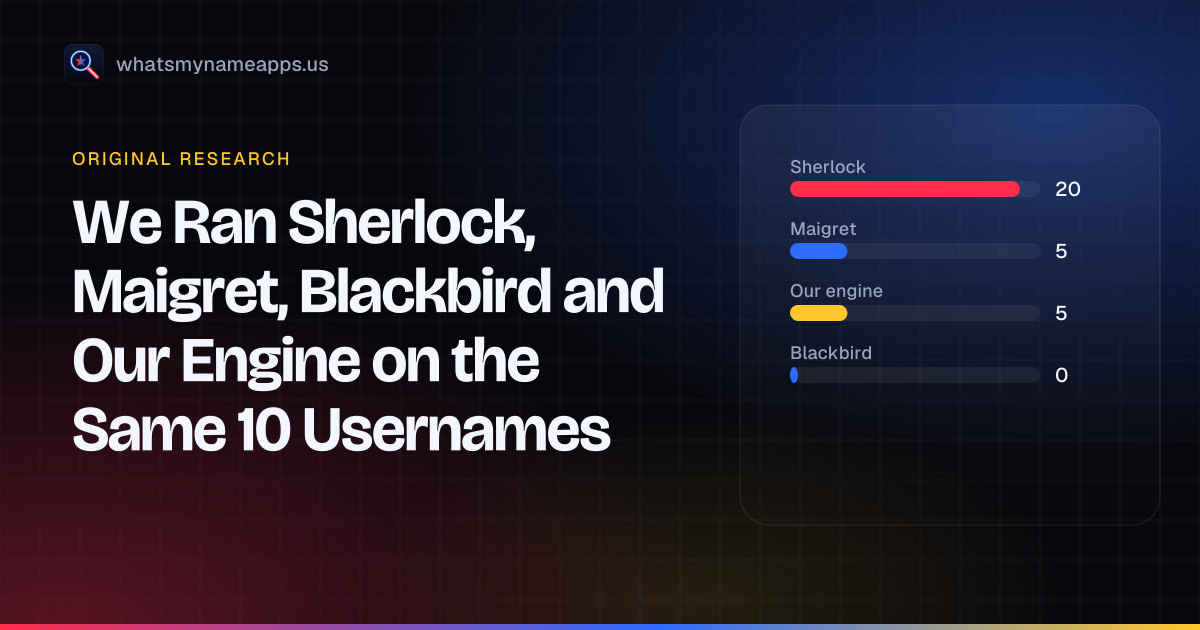
Most "Sherlock vs Maigret" articles compare feature lists. We wanted numbers, so on October 25, 2026 we installed Sherlock, Maigret and Blackbird on one Windows PC, ran each on the same 10 usernames with default settings, and ran the same names through our own engine. Disclosure up front: the fourth tool is ours. We report its weak spots the same way as everyone else's.
The short version: all four tools found roughly 100 to 150 profiles for well-known handles. On five made-up handles that should exist nowhere, Blackbird reported nothing, Maigret and our engine each reported one hit per name, and Sherlock reported four per name. The three command-line tools each took about 40 seconds per username. Our engine took about three minutes, but it checked 5 to 8 times as many sites.
Results at a glance
| Tool | Sites checked | Avg. found, 5 real handles | False positives, 5 made-up handles | Avg. time per handle |
|---|---|---|---|---|
| Sherlock 0.16.2 | 412 | 134 | 20 (4 per handle) | 39 s |
| Maigret 0.6.6 | 509 (its default top sites) | 149 | 5 (1 per handle) | 39 s |
| Blackbird (git c8329b2) | 692 | 137 | 0 | 41 s |
| Our engine (public API) | 3,457 | 102 | 5 (1 per handle) | 193 s |
Read the "found" column with care. Each tool checks a different list of sites, so a higher count means a bigger or differently chosen list, not better detection. We did not verify each of the roughly 2,600 found results for the real handles by hand, so this column says nothing about accuracy. The false-positive column is the one that measures something: a made-up 12-character string should exist on zero sites.
Found count per handle
| Handle | Sherlock | Maigret | Blackbird | Our engine |
|---|---|---|---|---|
| github | 127 | 65 | 142 | 108 |
| mrbeast | 144 | 182 | 153 | 101 |
| nasa | 169 | 214 | 160 | 143 |
| spotify | 143 | 179 | 149 | 99 |
| torvalds | 87 | 105 | 83 | 57 |
| 5 made-up handles (each) | 4 | 1 | 0 | 1 |
The made-up handles were qzvx7k2wplm3, j8rfn2xkq0wb, xw4pz9tlvq7m, k3mbq8zr2vny and t7yqh1xcw9df. Every tool gave the same count for all five, which tells you the hits come from sites that answer "yes" to any name, not from bad luck.
Maigret's low count for github stands out. That was the first run of the session and also its slowest (70 seconds), and its warnings that run flagged far more failed requests than on any other handle. We report it as measured.
False positives on the made-up handles
- Sherlock: AniWorld, F3.cool and BabyRu reported every made-up name as found. TikTok did too for four of the five, and Contently for the fifth.
- Maigret: FilmWeb, on all five.
- Blackbird: none.
- Our engine: one site (kudaizuna.top) on four of the five, and Minds on the other. Until those two rules are fixed, treat a “found” on either site as unconfirmed.
So in practice, almost all of these false positives come from a few broken site rules, not from noise spread across the list. Once you know which sites they are, you can ignore them. A newcomer reading the output usually doesn't know, and a false TikTok hit is the kind that sends an investigation the wrong way.
Errors and unclear answers
The tools report failures very differently, so these numbers do not line up neatly:
- Sherlock printed a reason for every site. On each handle, 35 to 38 of 412 sites (about 9%) ended in a connection error or other failure rather than Found or Not found, and 1 to 3 more were skipped because the name format was not allowed there.
- Maigret doesn't print a per-site error count by default. It does warn when an error type passes a threshold. Adding up those warnings gives at least 78 to 120 problem sites out of 509 on nine of the ten handles (mostly "bot protection" and connection failures), and 248 on the
githubrun. - Blackbird by default only prints found accounts, so we can't tell how many of its 692 checks failed.
- Our engine reports four statuses. Per handle, 110 to 169 sites (3 to 5%) came back Unknown and 1 to 4 Blocked.
The practical point: when a tool doesn't show its errors, a failed check looks exactly like "no account here".
Speed
Sherlock averaged 39 seconds per handle, Maigret 39 (36 if you leave out its slow first run) and Blackbird 41. Our engine averaged 193 seconds, with one slow run of 330 seconds. Per site, that works out to about 11 sites a second for Sherlock, 13 for Maigret, 17 for Blackbird and 18 for our engine.
That comparison is not apples to apples. The three CLI tools ran on the test PC and sent requests straight from a home connection. Our engine ran on its server, and we called it through the public website API in batches of 400 sites, one batch after another, the same way the website does. We never hit a rate limit.
Method
- Date and machine: October 25, 2026, one Windows 11 Pro PC (build 26100) on a home broadband connection, Python 3.12.3 in a fresh virtual environment, Node.js 24.18.0 for the API calls.
- Versions: sherlock-project 0.16.2 and maigret 0.6.6 from pip. Blackbird cloned from its GitHub repository at commit c8329b2 (October 17, 2026), since it is not on pip. Maigret updated its site database on first run (8,232 sites) and scanned its default top 509. Blackbird confirmed its downloaded site list was current (692 sites).
- Commands:
sherlock <name> --timeout 10 --print-all;maigret <name> --timeout 10 --dns-resolver threaded --no-recursion;python blackbird.py -u <name> --timeout 10 --json. Everything else was default.--print-allonly changes what Sherlock prints, so we could count not-found and error lines. - Two Maigret changes, and why: on our first attempt, Maigret's default DNS resolver failed on about half of all sites on Windows, and its own warning suggested
--dns-resolver threaded. By default Maigret also starts new searches for other usernames it finds on profiles, which makes runs incomparable. We turned that off. That first attempt was discarded, along with a second one we spoiled by running two copies at once. - Order: one handle at a time, one tool at a time (Sherlock, Maigret, Blackbird, then our engine), nothing in parallel.
- Timing: wall-clock seconds for each command, rounded to the second.
Download the results (CSV): one row per tool and handle with sites checked, found, not found, blocked, unknown or error, seconds, and the false-positive sites for each made-up handle. Empty cells mean the tool did not report that number.
Limitations
- Small sample. Ten handles, one run each. A second run on another day would give different numbers, because sites change their pages and blocking all the time.
- Defaults only. Every tool has options that change results: Maigret can scan all its sites with
-a, and all three accept proxies. We tested what a new user gets out of the box. - One network. Home IP addresses get blocked differently from servers. The CLI tools and our engine reached the sites from different places.
- No hand-checking of real-handle hits. We only judged accuracy on the made-up names. Missed accounts (false negatives) were not measured.
- Our own product. We built and run the fourth tool, and we wrote this article. We used its normal public API with no special settings, published its false positives, and put every number in the CSV so you can check our reading of them.
What to take from it
For a quick scan with almost no noise, Blackbird's default output was the cleanest in our test, though it also tells you the least about failures. Maigret gave the most hits on famous handles and one false positive per name, but on Windows it needs the DNS flag. Sherlock is easy to script, but expect a handful of sites that say "found" to anything. Our engine covers the most sites without installing anything and keeps Blocked and Unknown separate, and it is the slowest per username.
Whichever tool you use, run one made-up name first. Any site that answers "found" for gibberish is a site you can't trust for your real search. You can try ours with the username search, and our feature comparison of these tools covers what the numbers here leave out.
FAQ
Which username OSINT tool is most accurate?
On our five made-up handles, Blackbird had no false positives, Maigret and our engine one per handle, and Sherlock four. We did not measure missed accounts, so that is only half of accuracy.
Which tool is fastest?
Per username, the three command-line tools were close at 39 to 41 seconds. Per site checked, Blackbird and our engine were fastest at about 17 to 18 sites a second.
Why does Sherlock find accounts for names that don't exist?
A few site rules in Sherlock treat any page as a profile. In our run, AniWorld, F3.cool and BabyRu did this for every made-up name. These rules get fixed over time, so the list will change.
Can I reproduce this test?
Yes. Install the same versions, use the commands in the Method section, and run the handles listed above. Expect different numbers on a different day and network.
Is this test biased toward your own tool?
It could be, which is why we published the raw CSV, the exact commands and our own tool's false positives. Our engine was not the fastest per username and did not find the most profiles.
Related tools
Check a username now. Free, no sign-up, 3,450+ sites.

Search usernames on your phone. Get the free Android app. Scans run on your device.

Related in OSINT
- OSINT
Reverse Gamertag Lookup: Find a Player Across Games
Do a free reverse gamertag lookup online: check one name on Xbox, PlayStation, Steam, Riot and more, then run a deep username search across every site.
· 3 min read
- OSINT
How We Choose, Test and Re-Check the Sites We Search
How the WhatsMyName Apps username search decides a profile exists: how sites are added, how each rule is tested, nightly checks and what the four statuses mean.
· 3 min read
- OSINT
Find Someone's Other Accounts by Username (2026)
How to find someone's other accounts from one username: search every site at once, verify matches by hand, and stay inside the lines of responsible use.
· 4 min read
More from the blog
- Who Runs the Web's Profile Pages? 3,457 Sites Analysed (2026)
- The Username Format That Works on the Most Sites: We Tested 21 Formats Against 3,457 Sites’ Rules
- How to Find Someone's Alt Twitter (X) Account
- Username Availability Search: Is It Taken Everywhere?
- Digital Footprint Check in Canada: Free, No Sign-Up
- PIPEDA Privacy Rights and Quebec Law 25, Explained